

From Dr Bhabha’s Vision of indigenous nuclear research to the SMR Revolution.
Dr G Sateesh Reddy
India’s nuclear program stands as a testament to the nation’s quest for energy independence, scientific prowess, and strategic autonomy. Launched in the aftermath of independence, it has evolved from modest research endeavours to a multifaceted initiative encompassing power generation, defence and security and cutting-edge technologies. At its core has been the visionary leadership of Homi J. Bhabha, whose foresight laid the foundation for what has become a cornerstone of India’s energy strategy.
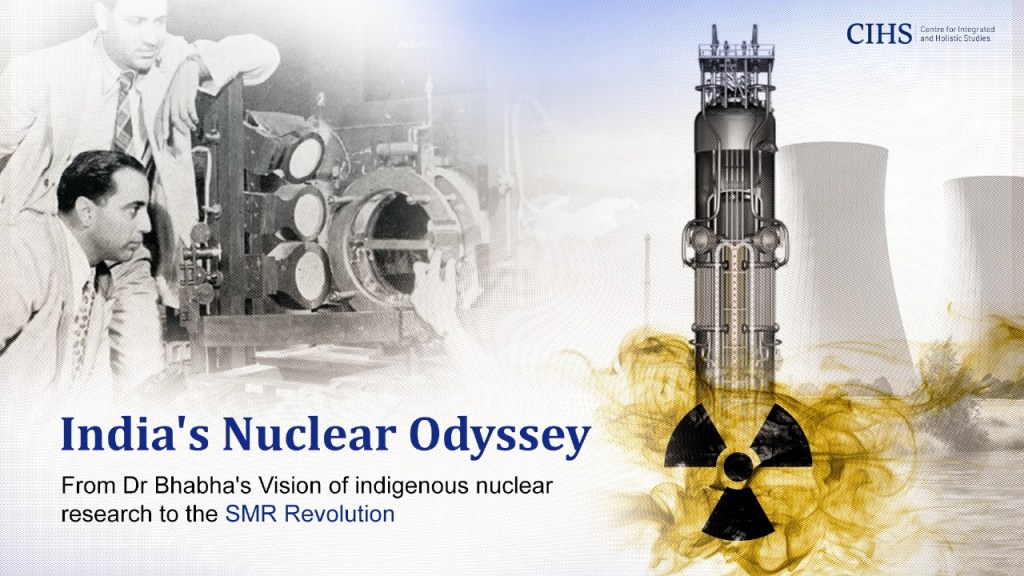
Today, with the world grappling with climate change and energy security challenges, India is pivoting towards Small Modular Reactors (SMRs) as a scalable, efficient solution to meet its burgeoning power needs. As of 2025, India’s nuclear capacity hovers around 8 GW, contributing only ~2% to the national electricity mix, but ambitious targets aim for 100 GW by 2047 under the Viksit Bharat initiative. A tall ask that requires a strong leadership and focussed integration of stakeholders.
The story of India’s nuclear program begins with Homi Jehangir Bhabha, often hailed as the “father of Indian nuclear science”. His work at the Indian Institute of Science in Bangalore followed by the subsequent incorporation of the Tata Institute of Fundamental Research (TIFR) in 1945 with support from the Tata Trust, laid the foundation for cosmic ray research and theoretical physics – thereby setting the stage for nuclear ambitions. Recognizing nuclear energy’s potential to propel a resource-scarce nation towards modernity, the Atomic Energy Commission (AEC) was also established just after independence followed by the formation of Department of Atomic Energy (DAE) with Dr Bhabha as its secretary – directly under the Prime Minister’s office to ensure autonomy and priority.
Early efforts focused on research reactors – APSARA a 1 MW swimming pool type reactor built in 1956, CIRUS a 40 MW reactor from Canada in 1960, and the indigenous Dhruva in 1985. Dr Bhabha’s strategy emphasized a three-stage nuclear cycle to leverage India’s vast thorium reserves (which as per DAE estimates is more than 1 mn tonnes today). The follow-on work was towards Pressurized Heavy Water Reactors (PHWRs) using natural uranium followed by Fast Breeder Reactors (FBRs) to breed more plutonium from uranium and uranium-233 from thorium and then Advanced reactors burning thorium for sustainable energy. Subsequently The Nuclear Power Corporation of India Ltd (NPCIL) was established in 1987 to handle commercial operations, building on Dr Bhabha’s indigenous focus and legacy.
The program accelerated amid geopolitical tensions – and the 1974 Pokhran-I test, codenamed “Smiling Buddha,” demonstrated India’s capability with a 15-kiloton plutonium device from CIRUS, billed as a “peaceful nuclear explosion”. This led to international sanctions, forming of the Nuclear Suppliers Group (NSG) and the isolation of India from global nuclear trade. Undeterred, India pursued indigenization. The first PHWR, Rajasthan-1 (100 MWe), went online in 1973, modeled on Canada’s CANDU design but adapted locally. The 1980s and 1990s saw a series of 220 MWe PHWRs at sites like Narora, Kakrapar, and Kaiga, with capacity factors improving from 60% in 1995 to 85% by 2002. The 1998 Pokhran-II tests (five devices, including a thermonuclear one) affirmed India’s nuclear weapons status. This further entrenched isolation until the 2005 Indo-US Civil Nuclear Agreement, formalized in 2008, leading to the NSG waiver.
Post-2008, milestones included the Kudankulam VVER-1000 reactors (1,000 MWe each). Indigenous 700 MWe PHWRs debuted with Kakrapar-3 achieving criticality in 2020. The Prototype Fast Breeder Reactor (PFBR, 500 MWe) at Kalpakkam reached advanced commissioning in 2025, with core loading starting in 2024. In 2024, the Fast Reactor Fuel Cycle Facility (FRFCF) was commissioned.
Recent developments include the Nuclear Fuel Complex (NFC) developing high-residual resistivity niobium ingots in 2025 for advanced applications. The 2025-26 Union Budget allocated funds for nuclear R&D, emphasizing clean energy transitions. India aims for 22.5 GW by 2031, and the Viksit Bharat 2047 strategy targets 100 GW.
Nuclear triad – Offshoots of the nuclear program
India’s nuclear weapons program has also evolved significantly, transforming from a nascent capability into a robust triad of land, air, and sea-based deterrence. Beginning with the Integrated Guided Missile Development Program (IGMDP) in the 1980s, India focused on indigenous missile technology to bolster strategic defence. The Prithvi series, introduced in the late 1980s, provided short-range nuclear-capable ballistic missiles (150-350 km), while the Agni family expanded horizons with Agni-I (700 km) in 1989, progressing to Agni-V (over 5,000 km ICBM) by 2012, and Agni-VI in development for even greater reach and with multiple independently targetable re-entry vehicles (MIRVs). These missiles, equipped with nuclear warheads, have enhanced India’s ability to deter aggression from adversaries.
A pivotal offshoot has also been the underwater nuclear program, emphasizing sea-based platforms for survivable second-strike capability. The Advanced Technology Vessel (ATV) project, initiated in the 1970s but accelerating in the 1990s, culminated in the Arihant-class nuclear-powered ballistic missile submarines (SSBNs). INS Arihant, commissioned in 2016, marked India’s entry into the elite club of nations with nuclear triads. Subsequent advancements include INS Arighat, commissioned in 2024, and ongoing builds like INS Aridhaman, featuring longer-range missiles tested successfully in recent years.
As offshoots of the nuclear program, these developments in defence and strategic deterrence have fortified India’s security posture, countering asymmetric threats and maintaining regional stability through a balanced, minimal yet credible arsenal. This evolution underscores India’s commitment to self-reliance in strategic technologies, deterring potential conflicts while adhering to global non-proliferation norms.
The Future: Small Modular Reactors as Game-Changers
Small Modular Reactors (SMRs) represent a paradigm shift for India’s nuclear future. These factory-built, scalable units (typically under 300 MWe) offer shorter construction times, lower upfront costs, enhanced safety through passive systems, and flexibility for remote or industrial sites. For India, with its uneven grid and high renewable intermittency, SMRs can provide baseload power, desalination, hydrogen production, and captive energy for industries.
The push began with the 2024-25 Budget’s “Bharat Small Reactors” announcement, based on 220 MWe PHWR tech. In February 2025, the Nuclear Energy Mission was launched, committing federal funds for five indigenous SMRs by 2033. BARC unveiled three designs in August 2025: a 200 MWe Bharat SMR, a 50 MWe SMR, and a 5 MWt high-temperature gas-cooled reactor for hydrogen. International ties also bolster this development including the LoI with France for SMR partnerships. The 2025-26 Budget allocated INR 20,000 crore for SMR development. Plans include deploying SMRs in remote areas, replacing coal plants, and co-generation. By 2047, SMRs could contribute significantly to the 100 GW target, requiring $217 billion in investments.
Despite progress India’s nuclear program faces headwinds including uranium supply volatility, public opposition fuelled by radiation fears, waste management as well as geopolitical risks. That being said, solutions are also emerging. Federal incentives like tax concessions, green classification, and the INR 20,000 crore funding can attract investments. More efforts are being made towards enhancing public awareness through campaigns and community engagement to build trust. Approval processes are being streamlined, brownfield expansions are being prioritized, and supply agreements are becoming more long-term contracts.
It is therefore important to continue to foster R&D for cost reduction, like indigenous IPWR (900 MWe), and through international collaborations for tech transfer. It is parallelly important to develop skilled manpower through domestic interventions as well as through global collaborations. Integrating nuclear with renewables for hybrid grids, and advance waste solutions can also help cater to the other headwinds that the sector faces.
India’s nuclear program, ignited by Dr Bhabha’s genius, has navigated isolation, innovation, and integration to emerge as a vital energy pillar. With SMRs poised to revolutionize access and efficiency, the path to 100 GW by 2047 is ambitious but achievable. Addressing challenges through policy reforms, partnerships, and public buy-in will be crucial. As India strides towards net-zero, nuclear energy by 2070 —clean, reliable, and indigenous energy options – holds the key to sustainable development.
(Author was formerly chairman of Defence Research and Development Organization and worked closely with Dr Kalam. Currently, he’s member of national security council)
 CIHS - Centre for Integrated and Holistic Studies