

Crown Prince of Abu Dhabi’s recent visit signals that both Bharat and UAE relations go beyond the normal, their global agenda huge!
Pummy M Pandita
A major milestone in strong Bharat-UAE relationship was marked with the visit of Sheikh Khaled bin Mohamed bin Zayed Al Nahyan, Crown Prince of Abu Dhabi to Bharat.

As both nations worked to re-evaluate their foreign policy in light of changing global landscape, strengthening ties between Bharat and UAE were indicative of a larger geopolitical shift.
Crown Prince’s visit represents a forward-looking recalibration of their priorities as both countries grapple with new challenges in areas like energy, commerce, security and diplomacy.
Throughout history, trade, energy cooperation and strong people-to-people ties have united Bharat and UAE. Sheikh Khaled’s first official trip to Bharat as Crown Prince served as re-affirmation of UAE’s intention to deepen this alliance across multiple dimensions.
United Arab Emirates continued to be Bharat’s third-biggest trading partner with annual trade volumes pegged at over $85 billion. But the visit’s emphasis on partnership’s new areas like digital innovation, renewable energy and defense made it more eventful.
The two countries seem to be in the midst of re-doing their foreign policy priorities to reflect a changing world order that increasingly values diverse relationships and regional alliances. The visit was also aimed at capitalizing on strengths of each other for mutual advantages for geopolitical and economic gains. Interestingly, Bharat positioned herself as a major player on international affairs and UAE looked to expand its influence beyond the Gulf region.
Geopolitical significance of Sheikh Khaled’s visit cannot be missed in the light of regional stability and security cooperation. Concerns about rise of extremism, maritime security in Indian Ocean and instability in Asia are shared by both United Arab Emirates and Bharat. Gulf’s strategic significance as a transit corridor for petroleum supplies and international trade makes both countries’ cooperation on security issues an imperative.
Bharat has been exporting more defense equipment and UAE is a key partner in this endeavour. Both countries have a stake in maintaining regional peace due to conflicts in the region and increasing maritime dangers in Indian Ocean. One major goal post achieved was increased cooperation on intelligence sharing, combined military exercises and counter-terrorism.
Strengthening economic cooperation was anticipated as a key outcome of the visit. And, this did happen by large measure. Both nations are currently looking at new opportunities though old energy trade still forms core of the relationship—Bharat imports a sizeable portion (currently holds 5.86 million[1] barrels of Abu Dhabi oil in its strategic reserves) of its crude oil from UAE. Sheikh Khaled’s visit coincided with big upheaval in global energy sector spurred by a move towards new and renewable energy sources.
During Crown Prince’s recent visit, Bharat-UAE Business Forum in Mumbai event was noteworthy. There were five major agreements concluded with an emphasis on food and energy security. Nuclear cooperation was cemented in energy sector with signing of a historic agreement between ENEC and NPCIL for operation and maintenance of the Barakah Nuclear Power Plant. Supply of LNG, crude storage and production concessions in Abu Dhabi also formed part of the energy deal. Food park project in Gujarat is a sign of strengthening agricultural cooperation between the two and highlighted a comprehensive strategy for mutual economic benefit[2].
With major firms including DP World (cargo and port operations), Sharaf Group (shipping and finance), Emaar (real estate) and Lulu Group (retail) having presence, UAE is Bharat’s fourth-largest investor. Big Indian companies like ONGC, Larsen & Toubro and Oberoi Group also have substantive presence in UAE owing to its stable political climate and investment-friendly business climate.
Bharat’s leadership in digital payments also formed part of cross-border investments and improved transaction efficiency through integration of Bharat’s Unified Payments Interface (UPI) and UAE’s Arabian Automated Network for Instant Payments (AANI). Rupee-Dirham collaboration pushes de-dollarization of both countries’ economies and challenges dollar hegemony. These tactical alliances support energy security and improve bilateral cooperation in important sectors.
Bharat is at centre of global renewable energy transition due to its ambitious goal of achieving net-zero emissions by 2070. With its investments in solar energy, hydrogen and green technologies, UAE has been setting the standard in the region. It is well-positioned to be a key player in Bharat’s green transformation. Collaborative efforts in sustainable energy, especially solar and hydrogen were major subjects of conversation during Crown Prince’s interaction with Indian officials. Convergence of these sustainability agendas also creates opportunities for further cooperation in fields like carbon capture technologies, electric vehicles and infrastructure.
The visit signifies renewed emphasis on economic diversification in addition to energy. The digital economy, innovation and AI-driven industries are becoming more and more important to both nations. In light of Bharat’s drive towards digital transformation and UAE’s Vision 2031, IT industry is a key target for international investment and collaborative ventures. The cooperation would expand into knowledge-based economies and move beyond conventional trade patterns with the signing of additional Memorandum of Understanding (MoU) in these sectors.
Importance of cultural diplomacy in Bharat-UAE relationship cannot be understated. Indian diaspora with approximately 3.5 million members living in United Arab Emirates is a vital conduit between the two countries. Sheikh Khaled’s visit further emphasized UAE’s commitment to developing a multicultural and open society where expatriates from Bharat play a crucial part in the country’s economy and social fabric.
The way Indian community has changed over past few decades is indicative of a more general change in Abu Dhabi’s financial requirements. Approximately 85 – 90 per cent of Indian population worked in manual and semi-skilled labour throughout 1970s and 1980s, when the country’s industrial growth depended heavily on these labourers.
But, when the service industry expanded significantly in 1990s, the makeup of the town started to shift. Number of professionals, business owners and white-collar workers increased over this period which was in line with the growing need for highly qualified individuals. Nowadays, professionally qualified people, business owners, and other white-collar workers, along with their families, make up about 35% of the Indian community. This change shows the community’s adaptability and emphasizes how it both contributes to and benefits from the changing economic environment. The workforce’s shift from being mostly composed of blue-collar workers to a more varied and highly qualified group highlights Indian diaspora’s adaptability and effective assimilation into a more intricate and dynamic economy. Initiatives for cultural interaction, like Bharat-UAE Cultural Festival, keep strengthening the bonds between two societies.
Crown Prince Sheikh Khaled’s visit to Rajghat was historic. This homage to Mahatma Gandhi, an epitome of non-violence, made by three generations of UAE leadership, represented lasting and deep-rooted relationship between the two countries, strengthened by mutual respect, peace, and ideals.
South Asia is entangled in a complicated web of geopolitics whereby international interventions and regional crises combine to produce an unstable atmosphere. The ongoing crises in Pakistan, Bangladesh, Myanmar, and Maldives all contribute to the instability of the region since they each present different difficulties that when taken as a whole jeopardize the general stability and security of the region. Situation is further complicated by the geopolitical objectives of global powers, particularly China and the United States. The geopolitical significance of this vital maritime corridor has increased because of the Sino-American competition in the Indian Ocean, which has grown as both countries compete for influence Bharat’s area. This combination of international strategic competition and regional unrest highlights how complex and unstable South Asia’s geopolitical environment is.
Bharat and UAE have increased their security cooperation in recent years, and Crown Prince’s visit strengthened defense relations even more. Concerns about the growth of extremism and instability in the region were shared by both nations, especially considering the ongoing wars in Asia. The increasing confidence between the two countries is reflected in Bharat’s defense exports to the UAE, which include training and equipment.
Additionally, to guarantee marine security in Indian Ocean region, Bharat and UAE have been cooperating. Strategic ports in UAE, like the one in Fujairah, provide Bharat an edge in protecting important maritime
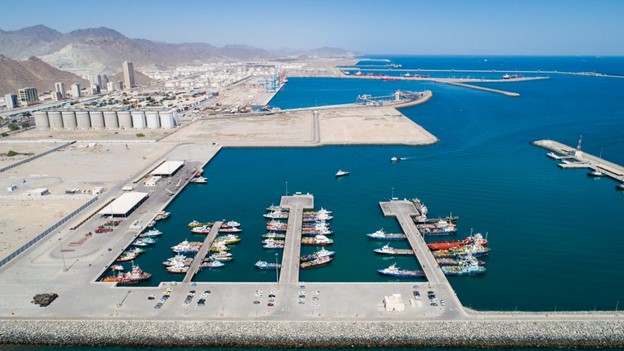
Figure 1 – Fujairah Port
lanes. The dedication of both countries to maintaining regional peace has already been shown by cooperative naval drills and counterterrorism initiatives.
The visit of Sheikh Khaled bin Mohamed bin Zayed Al Nahyan to Bharat is a significant sign of how the two countries’ relationship is developing, driven by similar geopolitical, economic, and cultural goals. After starting out as a trade and energy-based partnership, Bharat-UAE has developed their alliance into a multifaceted strategic alliance, positioning themselves as important regional powers in a world that is changing quickly.
Going forward, Bharat-UAE alliance will expand based on their capacities to collaborate, manage challenges such as energy security and regional instability. The visit is a declaration of intent, confirmation of shared values and evidence of growing consensus between UAE and Bharat on international, regional and economic issues.
Bharat and UAE relationship will be crucial in determining geopolitical environment of this century.
(Author is head of operations at Centre for Integrated and Holistic Studies based in New Delhi)
[1] https://www.al-monitor.com/originals/2024/09/india-uae-relations-move-crude-oil-imports-nuclear-cooperation
[2] https://www.firstpost.com/opinion/abu-dhabi-crown-princes-delhi-visit-india-uae-ties-scaling-new-heights-13814175.html
 CIHS - Centre for Integrated and Holistic Studies