

Silence and inaction against Islamist jihad by prioritizing Labour political gains is not an option for Keir Starmer.
Triveni Kaul
In early hours of a chilly autumn morning in 2023, news portals reported that a quiet neighbourhood in London turned into epicentre for unrest. Radical Islamic groups triggered by online calls took to streets in protest. What began as a demonstration soon turned violent with clashes between protesters and police, vandalism of public property and rising fear among local residents. These scenes of chaos were becoming disturbingly familiar across United Kingdom as growing influence of Islamic extremism escaped into public life. These protests were in support of Hamas (a proscribed terrorist outfit of Palestinian origin), who unprecedentedly launched attacks against Israel.
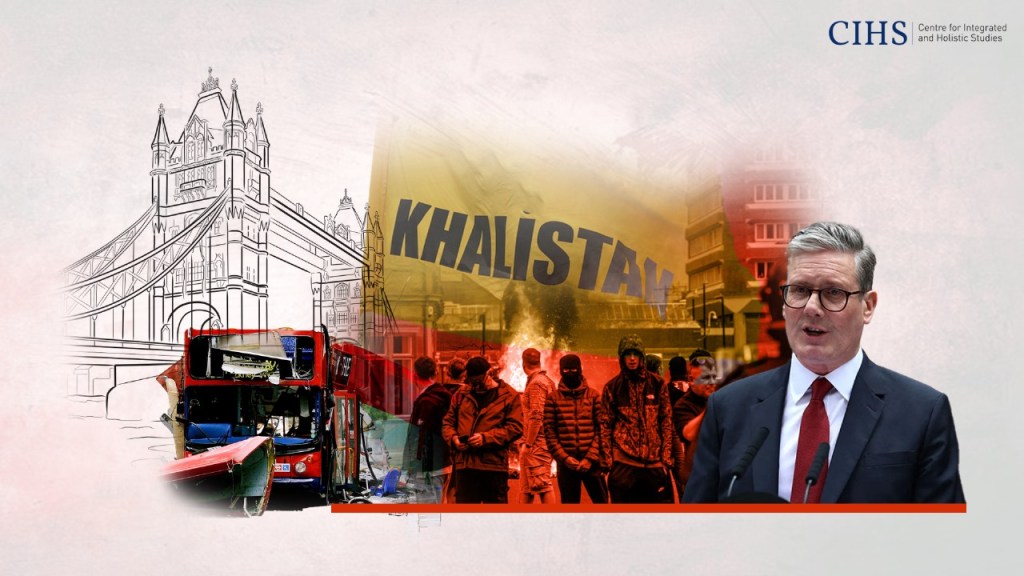
The violent Islamic protests are not isolated and they represent an alarming trend. Radical groups have utilised legitimate complaints to foment unrest leveraging social media to rally support and encourage violence. Radical Islamic protests in cities such as Birmingham, Leicester and London have frequently turned violent, leaving law enforcement scrambling to preserve order. The streets which were once calm have become battlegrounds for ideological extremism. Frustrated by what they regard as government’s ineffective reaction, some communities are taking upon themselves to demand tougher action from politicians who are supposed to safeguard them.
Keir Starmer, as Prime Minister, cannot afford to remain silent in the face of rising tensions. His responsibilities go beyond party politics; he must lead from the front in confronting risks to stability of UK’s multicultural society. Although Starmer has previously condemned violence, idea that his government has been overly cautious is hard to accept. Growing influence of Islamic extremists, particularly among vulnerable youth, continues to jeopardize the country’s security.
Islamic radicalism poses long-standing threat in UK. From the 7/7 London bombings to Manchester Arena bombing, country has experienced firsthand catastrophic effect of radicalization. While security personnel have determinedly fought terrorism, latest surge of protests shows that the situation is far from ending. Government’s response should go beyond statements, addressing underlying causes of radicalisation and implementing measures to prevent youth from being recruited into terrorism. Starmer’s stance on the other hand has been guarded, possibly overly cautious, as these movements gather traction.
At the same time, another major threat appears: Khalistani terrorism, a violent movement campaigning for an independent state in Bharat’s Punjab. Although the Khalistan movement has weakened in Bharat, it continues to receive support in United Kingdom, Canada, and the United States. Vast majority of British Sikhs are peaceful and oppose the extremist ambition of Khalistani radicals. However, a small group of fringe elements continue to advocate for the establishment of Khalistan, exploiting liberties of British society to advance their cause.
Supporters of Khalistan caused shockwaves across the nation last year when the Indian High Commission in London was attacked. In addition to damaging diplomatic ties, these kinds of acts put pressure on UK’s multicultural foundation. Even though Sikh communities have long been an essential component of British society, tensions are emerging both inside and outside the community as a result of these fringe elements. Starmer has a responsibility as prime minister to make sure that these movements don’t worsen rifts within communities or disturb the peace.
Labour Party leader’s appearance at Khalistani functions has triggered concern. Their attendance at the anti-terrorist 1984’s military operation in Bharat commemorated as Operation Blue Star sparked scrutiny. Pro-Khalistan advocates frequently use these events to further their extremist goal. It is imperative that Starmer dissociates himself from such radical elements in his capacity as prime minister and makes it explicit that his government will not stand for violent or terrorist beliefs in the UK.
The social stability of the UK is threatened by simultaneous rise of both Islamic and Khalistani extremism. Despite their differences, there is a commonality in both the movements as both are led by fringe elements that want to destabilise the country’s peace and order. While radicals from Khalistani outfits are promoting their divisive narratives, Islamic extremists are contesting the legitimacy of the government through violent gatherings. A major challenge is now facing the UK, which has long been renowned for its multicultural peace, as these extremist movements gain momentum.
The fact that these two radical groups, while having different objectives, frequently stand together against certain geopolitical concerns—such as their mutual hatred toward Indian institutions—makes the current state of affairs even more unstable. Because of this alignment of interests, which unifies various extremist elements under a similar flag of discontent, the threat is made much more deadly. The political establishment in the UK, particularly Prime Minister Starmer, needs to act decisively to confront these escalating dangers before they get out of hand.
Starmer is in charge of upholding social harmony, safety, and security throughout the country and diplomatic relations in his capacity as prime minister. His political party has a history of meddling in domestic affairs and supporting anti-Indian elements, but his leadership should reflect the nation’s dedication to maintaining the rule of law, promoting unity, and opposing radicalism in all its forms. His cautious response to extremism, both Islamic and Khalistani, has been viewed as insufficient thus far, leaving communities open to additional rifts and turmoil.
Inaction could have serious repercussions. The multicultural society of UK, which is sometimes cited as an example of integration and tolerance, has started to show indications of strain. There is a growing polarisation in communities and a decline in trust among different circles. Social cohesion can be easily undermined, as seen by recent incidents between violent Islamic protesters and counter-protesters from British communities. More bloodshed and divisiveness are inevitable if the government does not act more forcefully and decisively against these radical movements.
In short, the United Kingdom is at a pivotal moment in its history. Social stability and security of the country are seriously threatened by the rise of radical Islamist and Khalistani movements. In his role as prime minister, Keir Starmer needs to step up and lead with strength and decisiveness to safeguard the nation from these escalating threats. His duty goes much beyond party politics; it is about ensuring that the UK remains a secure, welcoming, and cohesive nation in future. Now is the time to take immediate action to ensure extremism, in all of its forms, is forcefully addressed and eliminated. Days of caution are over!
(Author is a corporate professional and foreign affairs enthusiast, she is a contributing writer at CIHS)
 CIHS - Centre for Integrated and Holistic Studies